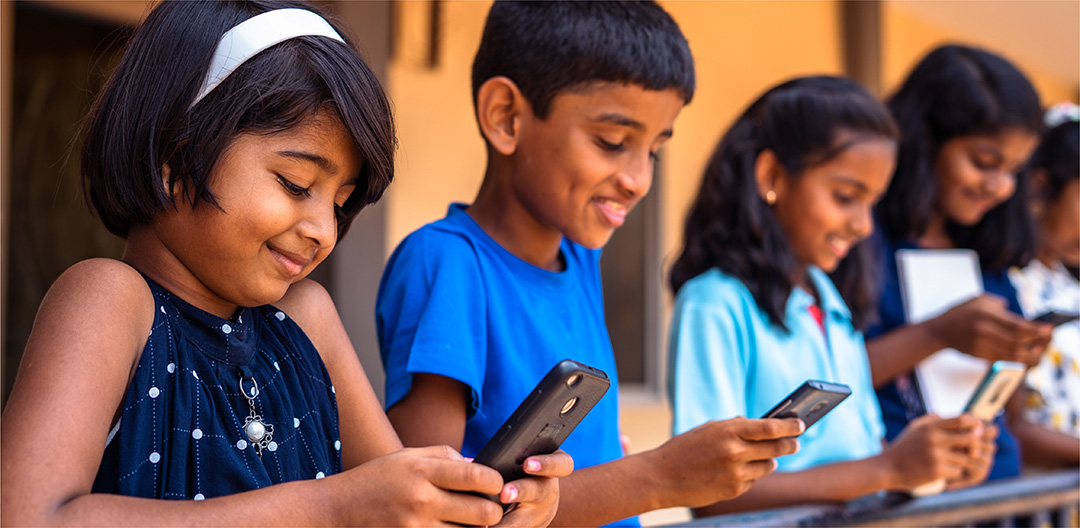

Creating safe, digital spaces, meaningful tech habits, and open dialogue for today’s young minds.
| In this article, you can explore: ✅ Raising children in a digitally-connected world ✅ Digital well-being: The real balancing act ✅ The silent harm of cyberbullying ✅ Gaming to Esports: Gaming together, growing together ✅ Virtual learning tools: Scrolling with purpose ✅ Social media guidance: Filters vs. feelings ✅ A global wake-up call |
- 3+ hours
- Social media. OTT. Gaming
- Unfiltered content. Unseen risks
According to a LocalCircles survey, 61% of urban Indian parents of children aged 9-17 reported that their children spend an average of three hours or more each day on social media, videos/OTT, and online games.
This reality changes the parenting equation. Without mindful screen time management, the line between learning and overload blurs quickly. In today’s time, parenting is about staying curious, staying available, and staying human.
Raising children in a digitally-connected world
Let’s face it: children are becoming digital natives. They explore, connect, create, and sometimes struggle through screens. What makes this challenging is how silent the struggles can be.
Across India, over 82% of Indian children between 14 and 16 years are smartphone users, but just 57% use them for learning. In contrast, 76% primarily use their devices to access social media.
This doesn’t mean screens are the enemy. But it does mean that parents need to bring digital well-being into their everyday parenting vocabulary.
Digital well-being: The real balancing act
Truth be told, digital well-being is about guiding children to use technology in ways that nurture learning, creativity, and rest. It requires habits that are realistic and repeatable.

“It is not how long we are using screens that really matters; it is how we are using them and what’s happening in our brain in response.” – Rich, Director of the Center on Media and Child Health, Boston Children’s Hospital & Associate Professor at Harvard T.H. Chan School of Public Health.
These choices teach children that mindful use matters more than minutes counted.
The silent harm of cyberbullying
Cyberbullying prevention is one of the toughest challenges for families and schools. Online bullying can take many shapes – being excluded from groups, cruel memes, mocking emojis, or impersonation.
According to the 2024 Silent Screams: A Narrative Review of Cyberbullying Among Indian Adolescents article by the National Library of Medicine, India has the highest incidence of internet harassment, with over 33% of children reporting having been the victim of it.

Gaming to Esports: Gaming together, growing together
While gaming can become overwhelming, it can also be structured into something constructive. Strategy games often sharpen problem-solving skills and improve hand-eye coordination.
India has now taken a formal step by recognising gaming and e-sports for kids as a competitive sport under the Online Gaming Bill 2025. For example, Krafton (the developer behind PUBG and BGMI) has launched an IPL-style franchise esports league in India, giving teenagers a regulated and professional platform.

………………………………………………………………………………………………
Rohini was folding laundry when she noticed her 11-year-old son, Kabir, staring blankly at his iPad.
“What’s wrong?” she asked gently.
He muttered, “Everyone’s gaming together online…they didn’t include me.”
Instead of scolding or grabbing the device, Rohini sat down beside him. “That must feel pretty rough, and you must have felt left out,” she said.
Kabir looked up, surprised that she understood him.
Together, they came up with a new plan: an offline challenge. That evening, they devised a “family carrom tournament board” on chart paper.
By bedtime, Kabir wasn’t sulking anymore; he was grinning, already asking, “Can we play another round tomorrow?”
………………………………………………………………………………………………………
Virtual learning tools: Scrolling with purpose
Learning now stretches beyond classrooms. Virtual learning tools are part of everyday study, offering interactive lessons and practice exercises. Even game-based platforms are being redesigned to introduce skills like coding, design, and teamwork.
But not every click equals learning. Parents can co-learn:
- Watch a class together.
- Ask, “What was engaging? What was confusing?”
- Discuss how lessons can apply in real life.
Co-learning builds comprehension, and more importantly, it builds connection.
Social media guidance: Filters vs. feelings
Social media shapes how children express and compare themselves to peers. Social media guidance is more about building awareness. Conversations help children distinguish between real and performative posts, reflect on how scrolling makes them feel, and pause when emotions shift toward insecurity.
In fact, Instagram and YouTube now allow screen usage reports and time reminders. Use them together with your child to build digital awareness. This turns tracking into a shared tool for online safety for kids, not a hidden control measure.
Impact of screen time on child development
The impact of screen time on child development depends heavily on how technology is used.
- Passive watching can create fatigue and distraction.
- Interactive storytelling or puzzles can build skills.
- Research and learning apps foster curiosity.
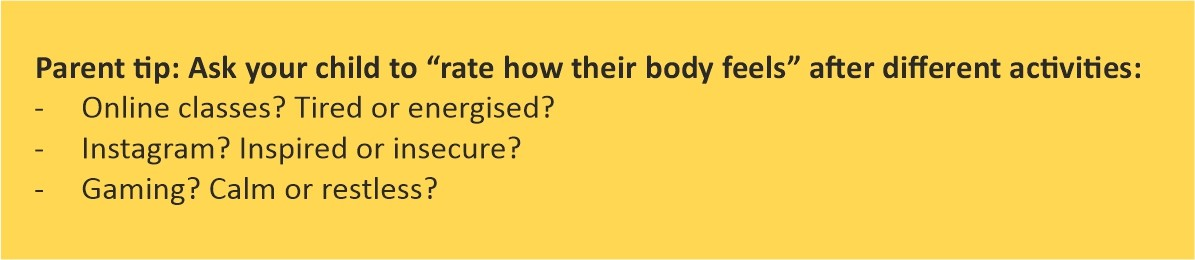
These simple reflections turn experiences into lessons in emotional literacy.
A global wake-up call
The concerns extend beyond India.
In Australia, a 2025 study published by the Psychological Bulletin was conducted among 2,92,000 children. The study highlighted how excessive screen time was linked to developmental problems, depression, and psychosocial problems.
Psychologist Jonathan Haidt, in his book “The Anxious Generation”, has mentioned that your child’s smartphone is a threat to their mental well-being. He and other child advocates suggest delaying smartphone access until age 14 or older, and reviving unstructured playtime as crucial.
A 2025 UNICEF report, Childhood in a Digital World, reveals that exposure to different forms of harmful content or hurtful experiences also affect children’s mental health negatively.
The global message is clear: awareness, balance, and connection are vital.
Your checklist for tech-smart parenting
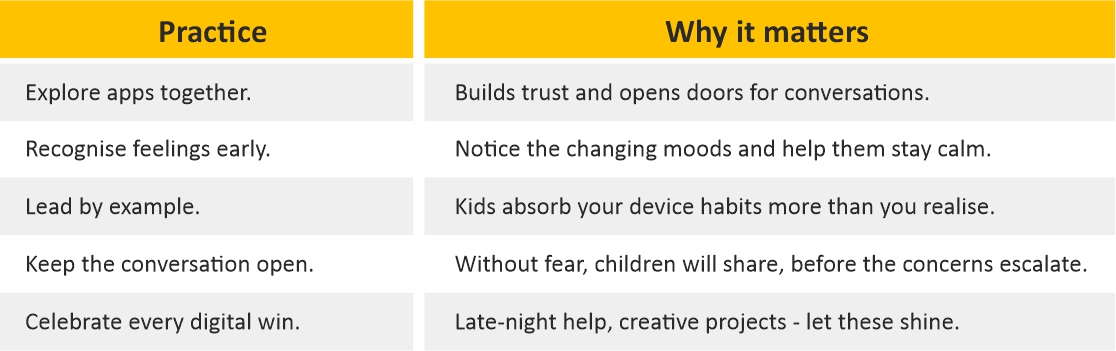
There is no perfect script for raising children in the digital age. What works for one child may not work for another. But one truth cuts across every home: children need parents who show up.
Digital well-being, safe internet use for children, and social media guidance, along with digital literacy for children are conversations to be lived, one day at a time. Parenting in 2025 should be focused on a steady presence behind the screen, which includes listening, guiding, and learning alongside your child.
Because when parenting starts with empathy and heart, even the most complex digital world becomes a safer, kinder place to grow.