
With virtual labs and digital resources, complex science concepts become simple, tangible, and deeply memorable.
| In this article, you can discover: ✅ Innovation labs: Science that gets built, coded, and tested ✅ Watching to doing: The digital transition in learning science ✅ The moment curiosity finds a window ✅ Real stories: Curiosity that didn’t stop at ideas ✅ Gamified learning: The “level up” in science ✅ A global glance: Innovators who made science feel human ✅ Nurturing a child’s love for science |
Science is cool, because did you know…
A cloud can weigh a million kilos.
Honey can last thousands of years.
The Sun’s core is hotter than lava.
These small truths linger in a student’s mind because they reveal the extraordinary inside everyday life. They invite children to look twice, ask more, and trust their curiosity.
That same spirit sits at the heart of National Science Day on 28th February, which honours Sir C.V. Raman’s discovery of the Raman Effect in 1928: a breakthrough born of patience, observation, and imagination. Today, that spirit lives inside tablets, virtual labs, 3D science simulations, and lively Innovation Labs in schools. Science appears more like a chapter and more like an experience students carry home in their questions, not only in their notebooks.
As curiosity grows, it deepens when students are given the space to make, test, and create.
Innovation labs: Science that gets built, coded, and tested
Innovation labs in schools provide the practical experience. Not just rooms with computers; they are hubs of project-based learning.
The Government of India reports that over 10,000 Atal Tinkering Labs (ATLs) now operate nationwide, reaching 1.1 crore+ students, making this one of the largest school innovation ecosystems in the world.
Within this ecosystem, the role of innovation labs in modern education becomes clear. At VIBGYOR Group of Schools, we have dedicated Innovation Labs focused on STEM, robotics, and AI, designed to foster a “maker” mindset. Our approach helps students practise problem-solving, logical thinking, collaboration, and ethical use of technology.
Once students have experienced science through making, digital tools help them see what their hands alone cannot.
Watching to doing: The digital transition in learning science
In many classrooms, science has long come alive via thoughtful teacher demonstrations, guided experiments, and well-structured lessons. These experiences help students develop clarity, discipline, and strong scientific habits in students.
Today, digital classrooms for science are adding a powerful new layer to this foundation. In a virtual science lab, students can:
- Repeat an experiment multiple times.
- Adjust one variable at a time.
- Instantly observe cause and effect.
- Restart comfortably without anxiety about mistakes.
Virtual Labs (VLABS), an initiative of the Ministry of Education (MoE), Government of India, now hosts over 175 labs and 1,500+ web-enabled experiments, giving students a chance to engage with high-quality simulations that closely mirror real laboratory procedures.
This shift matters emotionally. When mistakes can be undone with a click, children stop whispering, “I might be wrong,” and begin saying, “Let me try again.”
When students become more confident experimenting, they start wondering about what is happening below the surface – inside circuits, reactions, and forces they cannot actually see.
The moment curiosity finds a window
Many scientific ideas remain invisible to the naked eye – electrons moving in a circuit, molecules colliding, or forces acting at a distance. This is the power of 3D science simulations.
Platforms such as PhET Interactive Simulations allow students to rotate molecules, adjust forces, and observe their reactions in real time. A 2025 research article in the American Journal of Educational Research found that students’ interactions with virtual labs improved their ability to solve problems, critical thinking, and knowledge acquisition.
In India, Amrita OLabs support the CBSE/NCERT curriculum by presenting structured online experiments in Physics, Chemistry, and Biology, making it a helpful tool for practice and revision.
At this stage, interactive science learning stops feeling theoretical and starts feeling personal. This switch from seeing diagrams to truly understanding them gets clearer when we look at a single classroom moment.
A classroom moment that changed everything
For Vihaan, the shift became real one afternoon. He had stared at a circuit diagram for days, the arrows and symbols blurring together.
During the science period, he opened a PhET simulation, gradually dimmed the bulb, increased the resistance, and watched the current pulse gently. Later, in his school’s Innovation Lab, he rebuilt the same circuit with wires, a battery, and an LED. When the light shone exactly as he had predicted, he laughed – not because it worked, but because he finally understood why.
Vihaan’s point of realisation arrived through observing, testing, and then building with his own hands.
His experience mirrors what is happening in many parts of the country, where students are moving from understanding on-screen to impact in the real world.
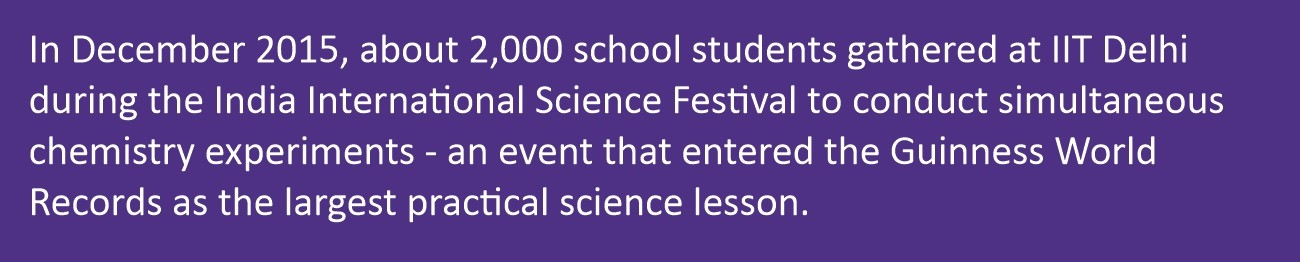
Real stories: Curiosity that didn’t stop at ideas Curiosity is no longer stopping at questions. Students are making, testing, and presenting ideas that matter in the real world. These stories show how hands-on science turns learning into practical impact.


These real-world examples show that when students create, momentum follows, and classrooms can sustain it through playful, game-like learning.
Gamified learning: The “level up” in science
Children can spend hours mastering a game because feedback is instant and progress is visible. Gamified science learning applies the same principle to classrooms through missions, badges, and levels.
Platforms such as Kahoot! and Classcraft have made routine quizzes into lively challenges, encouraging participation rather than pressure. In fact, the 2022 Impact of Gamification on Students’ Motivation article by ResearchGate mentions that gamification can provide additional motivation to students while increasing their behavioural, emotional, and cognitive involvement in learning.
One of the best examples of this is when a Class X student from Ponneri participated in the Southern India Science Fair (SISF) and designed an Arduino‑based password locker system that alerts people when the wrong code is entered.
This spirit of playful experimentation and curiosity has powered scientists across the world.
A global glance: Innovators who made science feel human
India has C.V. Raman, Dr. A.P.J. Abdul Kalam, and ISRO achievements that inspire deeply. A small global window broadens how students imagine scientists.
- Marie Curie: Known for her groundbreaking work on radioactivity, she transformed medicine and showed how patience, precision, and courage can change the world.
- Mae Jemison: A scientist, engineer, and the first African-American woman in space, who proved that imagination and science can travel together beyond Earth.
- Tim Berners-Lee: He invented the World Wide Web, demonstrating the fact that one idea connected the planet and opened knowledge to everyone.
- Katherine Johnson: Her calculations made early human spaceflight possible, proving that quiet brilliance can steer history.
- Tu Youyou: Her work on artemisinin saved millions of lives and reshaped global malaria treatment.
While inspiration matters, daily encouragement matters even more.
Nurturing a child’s love for science
When teachers and parents work in harmony, curiosity grows stronger, confidence deepens, and students feel safe to think, question, and create.
| What teachers can do | What parents can do |
| Inviting questions, not perfect answers | Celebrate questions over marks |
| Link lessons to real-world problems | Talk science in everyday moments |
| Normalise mistakes in learning | Allow safe tinkering at home |
| Encourage teamwork over competition | Value effort over comparison |
| Guiding students to more science fairs and activities | Support participation of your kids in fairs and clubs |
The next great Indian scientist may begin at a desk, a tablet, or an Innovation Lab bench — asking one brave question and trying again. On 28th February, let’s celebrate science as a way of thinking, creating, and caring for the world. With hands-on digital learning and strong STEM learning tools, every student gets a chance to lean in, wonder deeply, and build boldly.