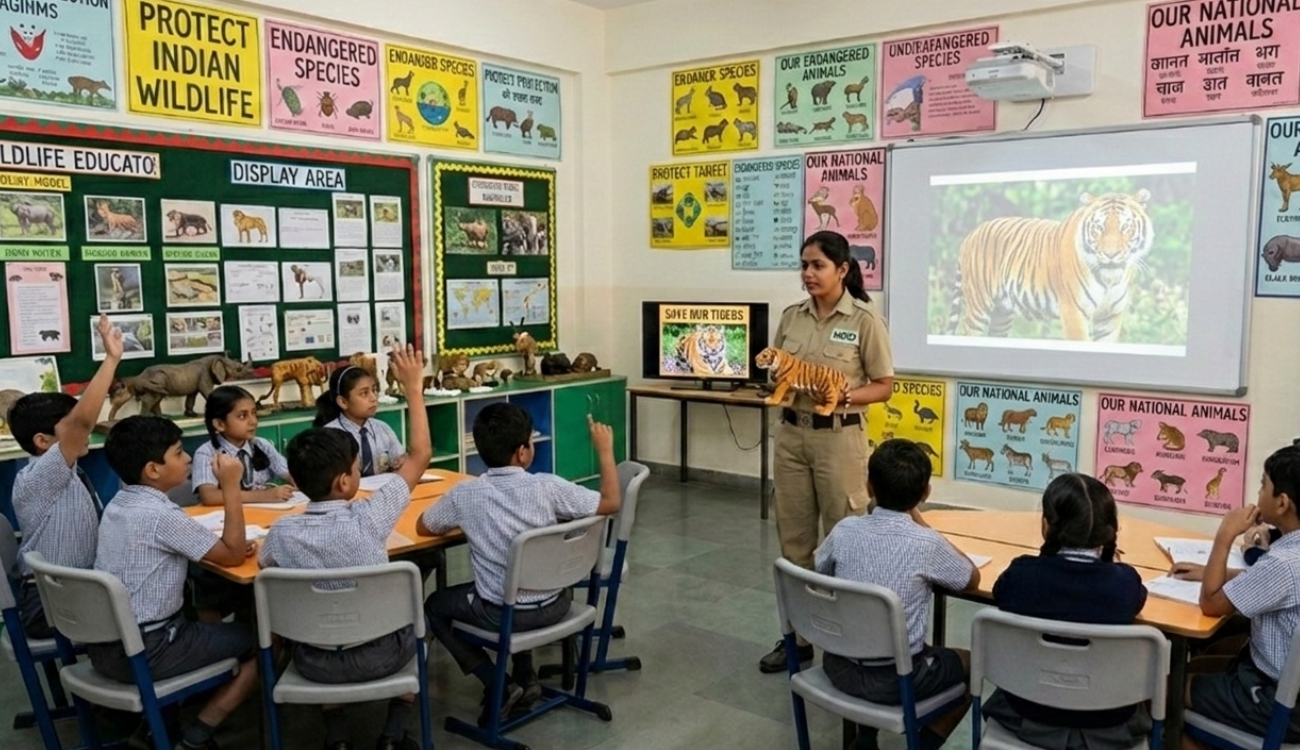
When schools teach caring for the wildlife through stories, science, and simple habits, students grow into guardians of nature.
| In this article, you can discover: ✅ A world that feels closer yet louder ✅ When learning becomes personal ➡️ The “First Real Moment” matters ➡️ The Elephant Whisperers: Empathy becomes the curriculum ➡️ The Wood Wide Web: Science that pulls children in,/P> ➡️ The Plogman energy: Conservation that feels like a sport ➡️ Loris Letters: The power of perspectives ✅ Learning that steps outside the four walls✅ Connecting curriculum to current events ✅ A parent’s role: The quiet co-authors |
Mowgli sprinting through the jungle in The Jungle Book.
Simba claiming his place on Pride Rock in The Lion King.
The tiny clownfish, Marlin, crossing oceans in Finding Nemo.
For many children, wildlife first arrives through the cinema. These scenes linger long after the screen goes dark. They stay etched in a child’s imagination. But a far more powerful question follows: what happens after the credits roll?
That question matters. Because admiration alone doesn’t protect forests, oceans, or animals. Action does. And the moment schools continue the story, wildlife shifts from fantasy to responsibility. Conservation stops feeling distant and becomes a choice children recognise as their own.
Jane Goodall said it best: “You cannot get through a single day without having an impact on the world around you. What you do makes a difference, and you have to decide what kind of difference you want to make.”
A world that feels closer yet louder
Heatwaves arrive early, and birds are vanishing quietly. News reports speak of elephants on highways and leopards near suburbs. Children absorb these stories without filters and ask questions that adults often struggle to answer. Schools are at the centre of this moment and serve as trusted spaces for students to enrich their minds.
India already has a nationwide framework that understands this urgency. The National Green Corps connects over 1,20,000 eco-clubs across Indian schools,giving students direct exposure to biodiversity, water, waste, and energy through hands-on work.
This highlights that school-based conservation programmes work best when learning stays local and practical.
Small habits that hold power
Conservation rarely begins with dramatic gestures. It often starts with repetition.
- Water bowls placed for birds during peak summer.
- Compost pits maintained week after week.
- Native saplings tracked across seasons.
These routines teach responsibility, and over time, nature conservation activities stop feeling symbolic and start feeling personal.
When learning becomes personal
Wildlife education works best when it moves from information to experience. These moments, felt, witnessed, or imagined, are instrumental in moving from awareness to care.
The “First Real Moment” matters
A poster about endangered species fades, but a lived moment remains in the mind for a long time.
For example, along Chennai’s coastline, students working with the Students Sea Turtle Conservation Network (SSTCN) join night patrols during the Olive Ridley nesting season. They help identify nests, protect them from disturbances, and later watch hatchlings move toward the sea.
This is wildlife conservation for students that settles in the heart first and then stays in their minds.
“The Elephant Whisperers”: Empathy becomes the curriculum
When The Elephant Whisperers won the Oscar, many children saw a beautiful story. For children living near elephant landscapes, it mirrors daily life. This is the moment schools can teach something essential: an elephant corridor is a survival path. A blocked corridor is a conflict waiting to happen.
Community-based work by the Nature Conservation Foundation in Tamil Nadu’s Gudulur focuses on coexistence approaches, such as early warning systems, that reduce surprise encounters.
Handled well, this becomes a powerful example of teaching wildlife protection in classrooms without fear or blame.
The Wood Wide Web: Science that pulls children in
Imagine a forest not as separate trees, but as a living underground network beneath the soil. This isn’t science fiction; it is known as the “Wood Wide Web”. Ecologist Suzanne Simard has noted that trees communicate via fungal networks, sharing nutrients and signals.
When school ecology programmes introduce this idea of interconnectedness into learning, science lessons move from theory to practical lessons. Students learn to map trees on campus, observe and track bird activity, and discuss how cutting one tree affects nature overall. This approach strengthens environmental education in schools by helping children understand responsibility, cause and consequence, and long-term impact.
The Plogman energy: Conservation that feels like a sport
Plogging began as a simple idea: picking up litter while jogging or walking. The word itself blends jogging and plocka upp (Swedish for “pick up”). What makes it powerful for students is its pace. It turns clean-up into a movement of teamwork and purpose.
This activity gained recognition when the Press Information Bureau highlighted Ripudaman Bevil leading the Fit India plog run, showing how environmental care can feel active and shared rather than obligatory.
When this idea is applied to school life, responsibility becomes participatory. It shows up as a timed campus clean-up relay, a simple before-and-after photo logs, or realistic pledges. These conservation activities for kids work because they invite repeat participation, not one-day enthusiasm.
Loris Letters: The power of perspectives
In Assam and parts of Northeast India, the Bengal Slow Loris is often captured for the illegal pet trade
because of its large, expressive eyes. Although it is a protected species, many people are unaware of the harm caused when it is taken from the wild.
To address this, some classrooms use a perspective-writing activity called Loris Letters. Students write a short note from the animal’s point of view, focusing on life in the wild and the stress of confinement. By engaging with living conditions rather than statistics, teaching wildlife protection in classrooms becomes empathetic and guides students toward responsibility without fear or instruction.
Learning that steps outside the four walls
Learning becomes sharper when children pause to observe rather than jump to conclusions. Outdoor learning experiences nurture observation, empathy, and better retention.
At Maharashtra Nature Park, thousands of students and educators participate each year in guided ecology walks led by trained naturalists. They walk through restored mangrove and scrub habitats, observe insects and birds up close, and discuss how urban development alters ecosystems. The focus is on observing leaf textures, soil moisture, and insect movement before naming concepts.
Outdoor learning experiences help children connect what they notice with how they feel. When learning begins with noticing, understanding lasts longer and strengthens environmentalprojectswithout relying on costly infrastructure.
Connecting curriculum to current events
The most powerful school-based conservation programmes begin with headlines children already hear at home.
Forest fires in Uttarakhand don’t stay confined to hill slopes; they travel through news screens into living rooms. Floods in Assam aren’t just about submerged homes; they reshape grasslands inside Kaziranga and push animals toward highways.
When teachers unpack these stories, children stop seeing events in isolation. They begin tracing connections between temperature and habitat, roads and migration, rainfall and survival. This is integrating conservation topics into the school curriculum through relevance, not repetition.
A parent’s role: The quiet co-authors Schools plant the seed, but it is the parents who nurture it and help it grow. Parents reinforce learning every time they pause at a headline, listen to a child’s observation, or support school initiatives.





This partnership shapes how students can participate in wildlife conservation beyond the classroom.
One last question
When children correct adults about waste or water, do we listen—or brush it aside?
The challenges facing wildlife are immense, yet the potential of the next generation is greater. When environmental education in schools builds empathy and action, children grow into thoughtful guardians. They carry stories forward through daily choices and shared responsibility, shaping a future where wildlife survives alongside us, by intent and by respect.