

A practical and balanced study plan that helps you revise and master your subjects with confidence and clarity.
| In this article, you’ll find: ✅ Why do the final 90 days matter? ✅ Three-phase blueprint: Your three-month study plan ✅ Mindset matters: Staying composed under pressure ✅ Parent-student equation: Creating a calm ecosystem ✅ The science behind smart preparation ✅ Global glimpses: Lessons from abroad ✅ 10-point checklist for students and parents |
Think of Virat Kohli’s unbeaten 82 against Pakistan in the ICC Men’s T20 World Cup 2022.
Or Jemimah Rodrigues’s fearless 127 against Australia in the semifinals of the 2025 Women’s T20 World Cup.
The same steadiness defines Rohan Bopanna’s focus in a tiebreak and Sundar Pichai’s rise, shaped by years of persistence. Success grows out of preparation and staying calm under pressure. Board exams work the same way – the groundwork is done, and this is the moment to put it into action.
This 90-day study plan for the CBSE board exam 2026 is designed around three principles – momentum, balance, and confidence that help students stay calm and perform at their best.
Why do the final 90 days matter?
For most Class X and XII students, the early months of the academic year are spent attending lessons, finishing projects, and taking internal tests. The last 90 days of preparation for board exams turn all that learning into readiness. This is the phase where habits settle, focus deepens, and clarity increases.
Studies have shown that structured learning helps students retain knowledge for an extended period and reduces their anxiety before exams. Small daily goals build discipline and confidence, creating a sense of control. A well-defined board exam strategy 2026can turn effort into steady progress and stress into purpose.
Three-phase blueprint: Your three-month study plan
Here’s a simple, three-month guide to help students and parents create an achievable and balanced plan.
Month 1: Building a strong foundation (Days 1-30)
Goal: Cover the whole syllabus once, clearly and systematically.
- Science and Maths: Solve 20-25 questions from previous years, every week.
- Languages: Practice grammar, essays, and writing formats daily for at least 30 minutes.
- Social Science: Prepare one-page chapter summaries for quick and easy recall.
Use Pomodoro cycles – 25 minutes of study followed by a five-minute break – to maintain better attention. The Impact of Spaced Learning on Student Performance and Motivation in Higher Education highlights how short breaks between focused sessions can improve memory and motivation.
Research also suggests that learning is more effective when students actively engage with the material rather than passively re-reading it.
The Strengthening Concept Learning by Repeated Testing article mentions that repeated retrieval strengthens long-term retention than simply re-reading notes.
Create a progress tracker to measure your growth every few days:
Subject Chapters completed Mock papers practised Confidence (1-5)
Update this tracker every few days. It provides a quick overview of what has been done, what remains pending, and how confident students feel about each subject.
Month 2: Practice and performance (Days 31-60)
Goal: Strengthen recall and sharpen accuracy.
By the second month, students should shift to performance-based learning. Attempt one mock paper every third day, focusing on a different subject each time. Begin with open-book tests to refresh concepts, then switch to closed-book, timed practice by mid-month. After each test, dedicate one hour to reviewing mistakes and patterns.
Psychologists emphasise that shallow repetition (reading over and over) doesn’t stick as well as meaningful engagement with the material, which supports the pattern of establishing a solid study timetable for board exams.
Practical tips for a smooth study cycle:
- Revisit weak topics regularly using your own error list.
- Schedule short group study sessions twice a week to clarify doubts.
- Stick to one subject instead of jumping between multiple subjects. This helps you stay focused and recall better. Avoid switching between subjects too often.
Set up a mock test calendar:
Mark the test days in red.
Mark the days for self-review of errors and tricky questions in blue.
This plan creates accountability, making your preparation more efficient during the last 90 days of preparation for board exams and helping the mind stay centred through the process.
Month 3: The final countdown (Days 61-90)
Goal: Refine, revise, and rest with purpose.
This is the polishing phase – use a subject-wise study plan for the board exam 2026 to revisit key areas and focus on strong revision techniques.
- Physics, Chemistry, and Math: Use flashcards to review formulas and practice numerical drills.
- History, Economics, and Political Science: Create timelines, mind maps, and flowcharts for events and key terms.
- Languages: Revisit past writing tasks, grammar exercises, and comprehension passages.
Rest is a crucial part of this cycle. The 2013 Sleep On It research found that lack of sleep can reduce learning ability by up to 40%. Seven to eight hours of sleep every night enhances retention and recall.
Evening routine reminder:
20 minutes of walking | 10 minutes of quiet reflection or gratitude journaling
Mindset matters: Staying composed under pressure
“Don’t let what you cannot do interfere with what you can do.” – John Wooden
The last stretch tests emotional endurance as much as academic preparation. During this phase, composure often decides performance. Staying calm matters more than chasing perfection. The board exam strategy 2026 is an opportunity to develop habits that build lifelong learners.
Try these techniques:
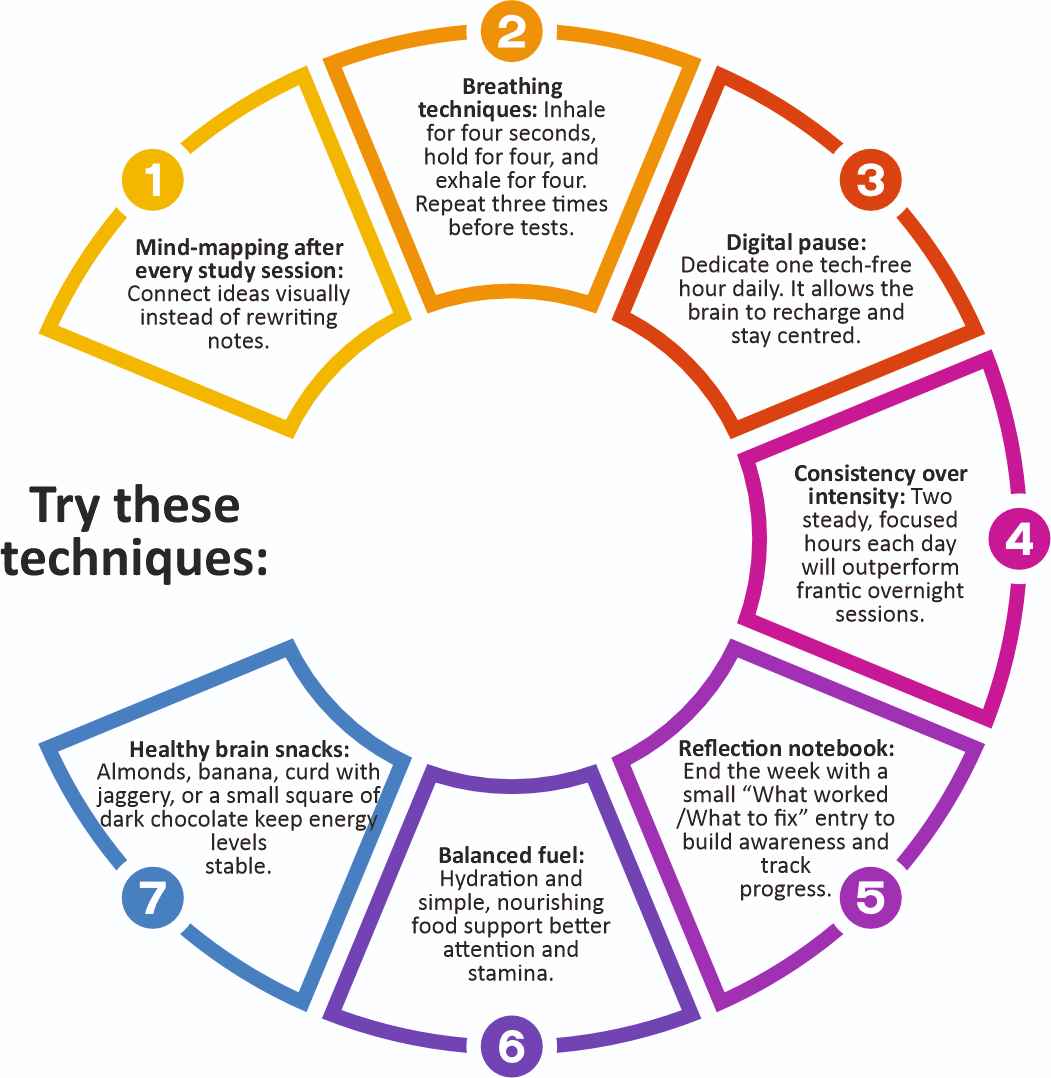
Ultimately, preparation is about balance – a calm mind paired with consistent effort always produces stronger results.
Parent-student equation: Creating a calm ecosystem
Board exam season can be as demanding for parents as it is for students. The anxiety of wanting children to do well often turns into pressure. What truly helps, though, is not constant reminders but calm routines, open communication, and steady encouragement.
How parents can help:
- Swap “Did you study?” with “How did your revision go today?” – it invites conversation instead of tension.
- Set aside one evening each week for family time – a walk, a movie, or a shared meal.
- Remind your child to rest. Short breaks between study sessions refresh the mind and improve memory.
According to reports, experts emphasise that parents should maintain open and positive communication with their children, helping them handle exam results with resilience and ensuring they never feel judged or compared.
Global glimpses: Lessons from abroad
In Singapore, schools emphasise self-regulated learning and reflective thinking as key 21st-century skills, encouraging students to plan, monitor, and reflect on their progress to build lifelong learning habits.
In Japan, “Kaizen learning circles” focus on continuous micro-improvement—a philosophy Indian schools can easily adapt. Both systems share one idea: steady progress beats sudden sprinting.
10-point checklist for students and parents
| 1. Keep a realistic timetable with balanced study and rest. | 2. Revise difficult chapters early in the day when energy peaks. |
| 3. Complete one subject at a time before switching. | 4. Attempt a full mock test every four or five days. |
| 5. Review mistakes regularly; note key takeaways. | 6. Sleep and wake up at fixed times. |
| 7.Stay hydrated and eat light, nutritious food. | Take digital breaks, especially before bedtime. |
| Use mind-mapping to connect ideas after study sessions. | Try the alternate nostril breathing technique before revision or tests. |
The last 90 days of preparation for board exams call for endurance and discipline. Each day strengthens intent and sharpens direction. A strong board exam strategy 2026 thrives on focus, structure, and steady progress. For students and parents – consistent effort, composed thinking, and faith in the process make preparation meaningful and lead to the desired results.