

Gentle routines, clear boundaries, and self-compassion lower parenting stress and strengthen attachment.
| Before we begin, here’s what this article offers: ✅ Why this conversation matters right now ✅ A pause that changed everything ✅ What we didn’t learn growing up ✅ The science behind self-care ✅ Why self-care is vital during exams ✅ Practical self-care tips for busy parents ✅ What children learn when they see self-care ✅ What self-care is not, and what it is |
Children don’t need a perfect parent.
They need a present one.
Anyone who has navigated parenting on low sleep, long workdays, and rising expectations knows that staying calm is not always easy. Parenting pulls energy from the deepest places, and that energy gets replenished through self-care for parents. Not through elaborate routines, but through tiny actions that hold you together: pausing before reacting, recognising when your mind feels stretched, and setting limits without guilt.
Over time, these small decisions shape the emotional climate at home. When you take care of your own well-being, your child sees balance, boundaries, and emotional safety in action. Self-care isn’t selfish; it sits at the centre of compassionate parenting.
Why this conversation matters right now
Parenting demands emotional presence every day, not just during big moments. As a parent, you try to hold everything together, often at the cost of your own rest. Children absorb this emotional climate instantly. This becomes even more evident during exam season, so self-care becomes a steady anchor rather than a seasonal fix.
The 2021 journal Academic Stress, Parental Pressure, Anxiety and Mental Health among Indian High School Students of Ludhiana, Punjab, shows a strong connection between parental pressure and test anxiety.
When a parent’s internal world feels overloaded, even a slight sigh or shift in tone can unsettle a child. Instead of giving attention to their textbook, they begin scanning the room for emotional cues.
The science behind self-care is simple: when you feel calm, your child feels more relaxed, too. Moreover, these patterns explain why self-care can also improve parenting.
A pause that changed everything
Radhika, a CA by profession, was highly involved in her son Rohan’s Class X exam preparation. She revised chapters with him, helped with practice papers, chased deadlines, and worked late into the night. In the process, she dropped her evening yoga and let her rest slide.
One February evening, she snapped at Rohan over a spelling error. Later that night, she realised that she had reacted not as a guiding parent but as a tired adult. The following week, she restarted her 20-minute yoga routine. She told Rohan, “If I do not stretch and breathe, I feel tense. You do not deserve the tense version of me.”
The change surprised both of them. Their study session felt calmer, and conversations opened up. This was also when Radhika realised how self-care makes you a better parent.
What we didn’t learn growing up
Many Indian households taught a different idea of strength. Adults once hid their tiredness, pushed through pain, and treated rest as a sign of weakness. Many parents grew up with that model, so they repeat it now – delaying their own needs, responding instantly, staying up late, and feeling guilty for wanting a pause.
This is why the importance of self-care for moms and dads runs deeper than it seems. Children watch everything, including how we treat ourselves. That becomes their template for adulthood. A template built on balance serves them far better than one built on burnout.

The science behind self-care
Parenting demands quick decision-making and emotional flexibility. When stress increases, the body enters fight-or-flight mode. This can turn small moments into big reactions.
Here’s what actually happens inside the body:
- The brain needs downtime to reset
- Stress hormones rise when rest is ignored
- Heart rate and breathing become faster when tension builds up
- The nervous system settles when you practice self-compassion
A recent meta-analysis of over 22,000 parents found a strong connection between high parental stress and reduced emotional well-being.
This chain explains why self-care for parents has long-term value – your emotional state silently shapes your child’s emotional development.

Why self-care is vital during exams
Children listen to instructions, but they react to the atmosphere. The way you enter a room, the pace of your breathing, the warmth in your voice – all of these signal safety or stress.
When your own needs get ignored:
- The body slips into survival mode
- Patience dries up
- Tone sharpens without warning
- Children assume they did something wrong
When mindful parenting and self-care guide your day:
- Your energy feels steadier
- Conversations soften
- Children feel safe asking questions
- Confidence rises naturally
Calmness at home comes when the parent has enough space within themselves to tackle and manage stress.
Practical self-care tips for busy parents
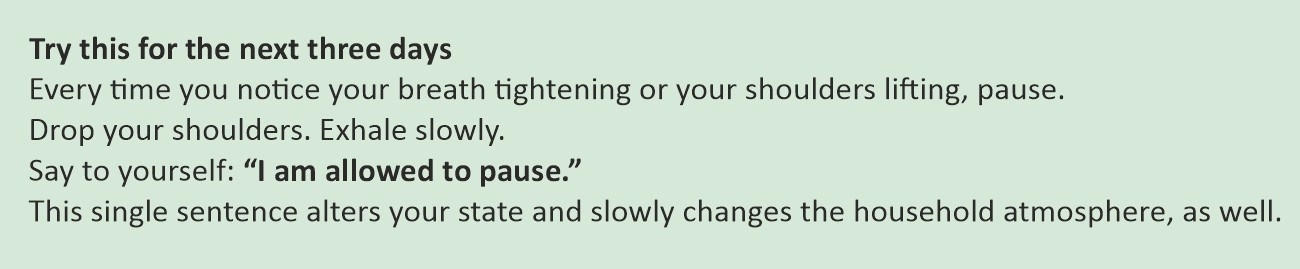
Most parents do not have extended hours for elaborate routines. That is why simple, repeatable habits work best. These ideas support mental health for parents in everyday moments.
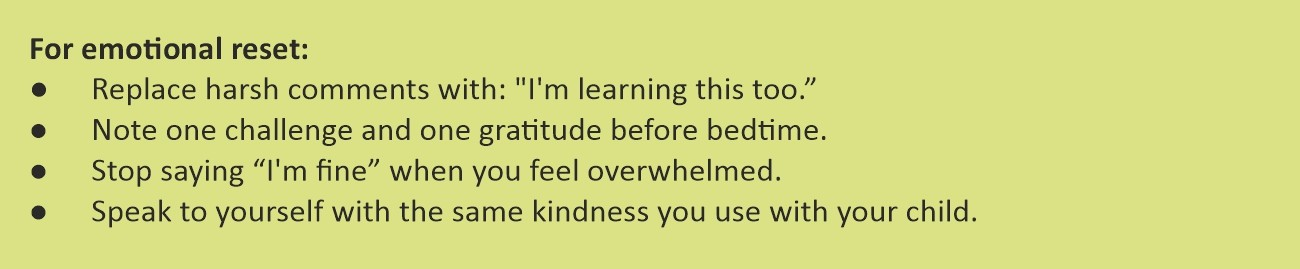


These practices maintain steadiness and prevent overload. They support long-term parenting and self-care without adding pressure.
What children learn when they see self-care
Self-care not only changes your emotional state, but also your physical state. It teaches children how to look after their own well-being. When they see you regulate, they learn how to regulate themselves.
Children internalise messages like:
- “I can say no when I feel overloaded.”
- “I can ask for space.”
- “My worth isn’t tied to an output.”
- “Rest is part of hard work.”
This is how self-care helps manage parenting stress and builds lifelong social-emotional skills in children.
What self-care is not, and what it is
| What self-care is not | What self-care is |
| ❌ Selfish ❌ A luxury ❌A reward ❌ Something to “earn” ❌ Only for mothers ❌ A trend | ✔️ Emotional hygiene ✔️ A simple regulation tool ✔️ Silent support for your child ✔️ A survival skill ✔️ The backbone of confident parenting |
Remember, you are not a machine raising a child. You are a human raising a human.
You do not have to hide your exhaustion or pretend to be strong every moment. Your child does not need a superhero; they need a grounded, steady adult. Self-care is the reminder that your needs matter too. It protects your health, shapes your home’s emotional climate, and teaches your child that balance is a strength. Strong parents repair, reset, and rise again, and every repair starts with one simple truth: self-care isn’t selfish. It is love in action.
Check out VIBGYOR Group of Schools’ recent webinar: Mindful Parenting: You and Your Teens’s recording explore practical strategies for cultivating a calm, connected, and supportive relationship with your teenage children while taking care of yourself..