Why Self-Care is an Essential Parenting Skill

Loading

Gentle routines, clear boundaries, and self-compassion lower parenting stress and strengthen attachment.

Before we begin, here’s what this article offers:
✅ Why this conversation matters right now
✅ A pause that changed everything
✅ What we didn’t learn growing up
✅ The science behind self-care
✅ Why self-care is vital during exams
✅ Practical self-care tips for busy parents
✅ What children learn when they see self-care
✅ What self-care is not, and what it is

Children don’t need a perfect parent.

They need a present one.

Anyone who has navigated parenting on low sleep, long workdays, and rising expectations knows that staying calm is not always easy. Parenting pulls energy from the deepest places, and that energy gets replenished through self-care for parents. Not through elaborate routines, but through tiny actions that hold you together: pausing before reacting, recognising when your mind feels stretched, and setting limits without guilt.

Over time, these small decisions shape the emotional climate at home. When you take care of your own well-being, your child sees balance, boundaries, and emotional safety in action. Self-care isn’t selfish; it sits at the centre of compassionate parenting.

Why this conversation matters right now

Parenting demands emotional presence every day, not just during big moments. As a parent, you try to hold everything together, often at the cost of your own rest. Children absorb this emotional climate instantly. This becomes even more evident during exam season, so self-care becomes a steady anchor rather than a seasonal fix.

The 2021 journal Academic Stress, Parental Pressure, Anxiety and Mental Health among Indian High School Students of Ludhiana, Punjab, shows a strong connection between parental pressure and test anxiety.

When a parent’s internal world feels overloaded, even a slight sigh or shift in tone can unsettle a child. Instead of giving attention to their textbook, they begin scanning the room for emotional cues.

The science behind self-care is simple: when you feel calm, your child feels more relaxed, too. Moreover, these patterns explain why self-care can also improve parenting.


A pause that changed everything

Radhika, a CA by profession, was highly involved in her son Rohan’s Class X exam preparation. She revised chapters with him, helped with practice papers, chased deadlines, and worked late into the night. In the process, she dropped her evening yoga and let her rest slide.

One February evening, she snapped at Rohan over a spelling error. Later that night, she realised that she had reacted not as a guiding parent but as a tired adult. The following week, she restarted her 20-minute yoga routine. She told Rohan, “If I do not stretch and breathe, I feel tense. You do not deserve the tense version of me.”

The change surprised both of them. Their study session felt calmer, and conversations opened up. This was also when Radhika realised how self-care makes you a better parent.


What we didn’t learn growing up

Many Indian households taught a different idea of strength. Adults once hid their tiredness, pushed through pain, and treated rest as a sign of weakness. Many parents grew up with that model, so they repeat it now – delaying their own needs, responding instantly, staying up late, and feeling guilty for wanting a pause.

This is why the importance of self-care for moms and dads runs deeper than it seems. Children watch everything, including how we treat ourselves. That becomes their template for adulthood. A template built on balance serves them far better than one built on burnout.

The science behind self-care

Parenting demands quick decision-making and emotional flexibility. When stress increases, the body enters fight-or-flight mode. This can turn small moments into big reactions.

Here’s what actually happens inside the body:

  • The brain needs downtime to reset
  • Stress hormones rise when rest is ignored
  • Heart rate and breathing become faster when tension builds up
  • The nervous system settles when you practice self-compassion

A recent meta-analysis of over 22,000 parents found a strong connection between high parental stress and reduced emotional well-being.

This chain explains why self-care for parents has long-term value – your emotional state silently shapes your child’s emotional development.

Why self-care is vital during exams

Children listen to instructions, but they react to the atmosphere. The way you enter a room, the pace of your breathing, the warmth in your voice – all of these signal safety or stress.

When your own needs get ignored:

  • The body slips into survival mode
  • Patience dries up
  • Tone sharpens without warning
  • Children assume they did something wrong

When mindful parenting and self-care guide your day:

  • Your energy feels steadier
  • Conversations soften
  • Children feel safe asking questions
  • Confidence rises naturally

Calmness at home comes when the parent has enough space within themselves to tackle and manage stress.

Practical self-care tips for busy parents

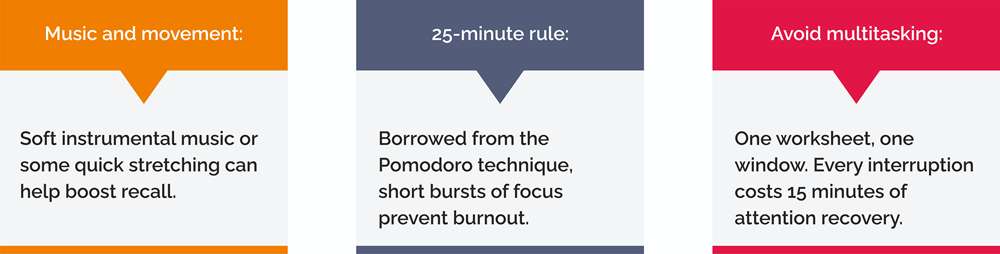
Most parents do not have extended hours for elaborate routines. That is why simple, repeatable habits work best. These ideas support mental health for parents in everyday moments.


These practices maintain steadiness and prevent overload. They support long-term parenting and self-care without adding pressure.

What children learn when they see self-care

Self-care not only changes your emotional state, but also your physical state. It teaches children how to look after their own well-being. When they see you regulate, they learn how to regulate themselves.

Children internalise messages like:

  • “I can say no when I feel overloaded.”
  • “I can ask for space.”
  • “My worth isn’t tied to an output.”
  • “Rest is part of hard work.”

This is how self-care helps manage parenting stress and builds lifelong social-emotional skills in children.

What self-care is not, and what it is

What self-care is notWhat self-care is
❌ Selfish
❌ A luxury
❌A reward
❌ Something to “earn”
❌ Only for mothers
❌ A trend
✔️ Emotional hygiene
✔️ A simple regulation tool
✔️ Silent support for your child
✔️ A survival skill
✔️ The backbone of confident parenting  

Remember, you are not a machine raising a child. You are a human raising a human.

You do not have to hide your exhaustion or pretend to be strong every moment. Your child does not need a superhero; they need a grounded, steady adult. Self-care is the reminder that your needs matter too. It protects your health, shapes your home’s emotional climate, and teaches your child that balance is a strength. Strong parents repair, reset, and rise again, and every repair starts with one simple truth: self-care isn’t selfish. It is love in action.

Check out VIBGYOR Group of Schools’ recent webinar: Mindful Parenting: You and Your Teens’s recording explore practical strategies for cultivating a calm, connected, and supportive relationship with your teenage children while taking care of yourself..

When Homework Feels Heavy, Become Their Calm

Loading

Help your little ones view every assignment as an opportunity to grow, reflect, and take pride in their efforts.

In this article, you’ll find:
✅ The homework paradox
✅ The new homework hour: A mirror into modern parenting
✅ Building a safe homework zone
✅ Parent support, not parental control
✅ The global homework debate
✅ Homework and family dynamics
✅ Focus without frustration
✅ Managing stress without losing connection
✅ Collaboration over competition
✅ Strengthening the circle of support

“Mom, I can’t do this.”

“You can. Let’s look at it together.”

Think back to your own childhood. Remember those evenings spent figuring out equations or essays under your parents’ watchful eyes? The frustration, the sighs, the small triumphs? Homework has evolved, from pen-and-paper to projects and digital learning, but one thing remains constant: the need for support. Today, helping kids with homework is about creating a space where they feel safe to try or to make mistakes. Supporting them through this process often reveals more about their strengths than any grade ever could.

The homework paradox

Across India, homework time often becomes a daily balancing act. Parents want to help but usually find themselves torn between encouragement and expectations.

According to the National Council of Educational Research and Training (NCERT) survey, 81% of students reported that studies, exams and results caused them anxiety. In fact, schools in South Korea assign their students an average of 2.9 hours of homework per week, a relatively low amount.

In India, however, long assignments, tuition routines, and limited downtime create a culture of fatigue. Yet, small changes at home can redefine this experience. Effective study habits begin right at the dining table – by listening, pacing, and softening the tone.


A scene that plays out everywhere

Homework time can feel familiar – lessons waiting, parents guiding, and children hesitating. Between corrections and encouragement, emotions run high. A little patience, a listening ear, and the right approach transforms tension into teamwork.

This is where homework strategies and parent homework support make a difference.


The new homework hour: A mirror into modern parenting

In many cities, 7 p.m. to 9 p.m. has unofficially become “homework prime time.” Parents close their laptops, children unpack their books, and fatigue sits between them disguised as focus. What was meant to build confidence often ends up being a test of patience.

So what is the new rule: less correction, more connection

Because children remember how homework felt, not just what it contained. Gentle guidance helps in supporting student learning and building good study habits.

Building a safe homework zone

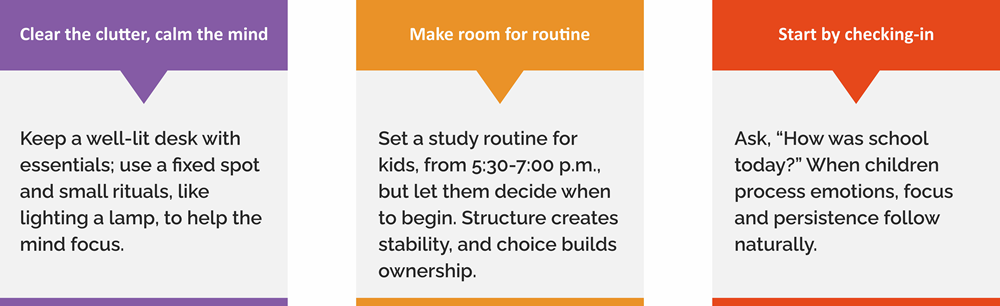
Before focusing on grades, focus on comfort. A study routine for kids begins with safety, physical and emotional.

Parent support, not parental control

The 2024 Academic Motivation in Adolescents article highlights that when parents offer autonomy-supportive help, children display higher academic motivation. The difference often lies in tone:

“Show me how you tried solving this” sounds vastly different from “Why can’t you get this right?” In India, especially, parents often become de facto tutors.

Try these:

  • Ask your child to explain what needs to be done.
  • Listen without interrupting.
  • Guide only when they ask for clarity.
  • Celebrate the efforts more than the completion.

By giving space and empathy, you are supporting student learning, not supervising it.

The global homework debate

CountryHomework focusKey idea
FinlandMinimal homeworkLearning through play
JapanPractice with reflectionBuilding discipline and routine
USABalanced homework policiesEncouraging independent conversation
IndiaQuantity-driven assessmentsSlowly shifting to skill-based work

As classrooms across India evolve with new learning approaches, homework, too, is changing. Schools are gradually shifting toward educational support for children that values creativity, curiosity, and collaboration.

Homework and family dynamics

Homework in Indian homes is rarely solitary. It is surrounded by grandparents’ advice, siblings’ chatter, and parents multitasking. Let children use this to their advantage.

Encourage your kids to share how they memorised poems or solved math problems in their time. It builds connection and perspective. Let siblings quiz one another; occasional chaos often makes learning assistance at home feel joyful and human.


Learning by the spoonful

Take a mother, Lavanya’s example – her son, Vicky, finally understood fractions when his grandmother used cooking to teach the principles: “Three cups of rice, one of daal – how much will be needed for six people?” The math stuck because the moment did. This is what kid-friendly study tips look like in real life.


Focus without frustration

Children often struggle to concentrate, especially after long school hours. Instead of enforcing the need to focus, try building it through gentle cues.

A systematic review found that classroom-based short physical and mindfulness breaks support attention and reading comprehension, which boost overall academic success.

Managing stress without losing connection

Homework stress often comes from fear of disappointing parents. Shift the after-study conversation. Instead of “Did you finish everything?”, ask them:

  • “What was the most interesting thing you learnt today?”
  • “Which part was a bit more challenging?”
  • “What would you like to try differently tomorrow?”

These questions nurture resilience and homework stress relief by shifting focus from results to learning.

Collaboration over competition

Teachers and parents share the same goal,  nurturing a child’s growth through shared understanding. When communication stays open, homework goes from a struggle to a shared journey.

The Parents’ and Teachers’ Perceptions of Home-School Journaling as an Effective Method of Two-way Communication and Collaboration research mentioned that teachers shared weekly notes highlighting each child’s favourite activities, areas in which the student excelled, and areas that needed improvement. This consistent sharing helped parents feel more connected to their child’s learning and better equipped to support them at home.

Simple messages such as “She found this topic tricky; could we try another method?” open dialogue and show teamwork. Empathy, when shared, strengthens educational support for children far beyond the classroom.

Strengthening the circle of support

Small actions strengthen the bond between teachers and parents, transforming homework into a shared growth experience.

Keep a two-way journal

  • Exchange brief weekly notes on what the child enjoyed, struggled with, or learnt – making daily updates possible.

Set common learning goals

  • Agree on a few shared goals each term, such as reading, confidence-building, or time management, so home and school reinforce progress consistently.

Use positive language

  • Focus on progress instead of errors; positive, specific feedback keeps children encouraged and motivated to keep trying.

Share learning moments

  • Exchange small real-life examples of learning – solving a puzzle, cooking, or reading together – to connect classroom lessons with home life.

Keep conversations open

  • Replace formal updates with friendly, ongoing chats. A quick voice note or email helps bridge understanding before challenges now.

Homework will always be part of growing up, but how families hold that time defines its meaning. Across India, parents are quietly transforming homeworkinto a ritual of connection and balancing homework and playinto everyday life lessons. By shifting from correction to collaboration, tension to teamwork, and routine to reflection, parents help children build lifelong learning habits rooted in patience, purpose, and quiet confidence.

Because helping kids with homework is about shaping how they will face every question life brings: with curiosity, calm, and courage.


Top